We Couldn’t Do This Alone: Celebrating a CSO Permit Milestone

Sewage overflow warning sign in Jersey City. Photo credit: Andrea Sapal

As we entered the new year, New Jersey passed a quiet yet long-awaited milestone in its journey toward cleaner and healthier waterways for all New Jerseyans. All combined sewer overflow Long-Term Control Plans (LTCPs) and the associated five-year permits have now been released and commented on. Six out of the seven regional plans have been finalized.

This process has been a multi-phase and multi-year effort. From 2019 to 2021, this was the phase during which permittees submitted their LTCPs, and from December 2022 to 2025, draft permits were released for public comment and finalized. These permits and the structured CSO implementation process are crucial for impacted community members to influence policy and infrastructure decisions that affect flooding in their overburdened neighborhoods and pollution in their water bodies. 

The Sewage-Free Streets and Rivers (SFSR) Campaign and its partners played a crucial role in this regulatory review process. Over these past three years, SFSR partners have reviewed and submitted recommendations on the seven regional draft permits released by the New Jersey Department of Environmental Protection (NJDEP). The comments focused on the following issues:

  • Timing, Financing, and Affordability 
  • Public Health: Notifications 
  • Strong Public Engagement 
  • Adapting to Climate Change and Updating Models 
  • Construction, Operations, and Maintenance: Transparency and Enforcement
  • Maximizing High-Impact Green Infrastructure 

Thank you to the following individuals who have participated in the permit review team over the last three years: Michele Langa, Vin Rubino, Nicole Miller, Dan Van Abs, Andy Kricun, Jose Amarante, Amy Goldsmith, Rosana Pedra Nobre, and Chris Obropta.

Our Recommendations

Overall, the review team found that NJDEP and the permit holders incorporated stringent requirements in certain areas, including public participation, resilient design standards, and infrastructure maintenance. Some of these requirements directly resulted from prior advocacy during the LTCP process and earlier regional permit releases. However, the team identified areas that needed strengthening across the permits, including affordability, shortening timelines, diversifying funding sources, reevaluating project sequencing, and ensuring meaningful community participation.

Final CSO permits have been issued for six regions, based on the draft permits and written and oral comments submitted. The seventh and final region, comprising the Middlesex County Utilities Authority and the City of Perth Amboy, had its draft permits released in November 2025, followed by a comment period that closed on January 5, 2026. Although the final plans have yet to be finalized, we recognize the plan submissions and the extensive review process as a significant milestone and a step forward toward cleaner, healthier waterways for all New Jerseyans. 

While the permit review process may have ended, the work does not end here.

What Comes Next?

With the staggered release of the regional CSO permits completed, New Jersey has shifted to an implementation phase. Here are the main things we will be monitoring:

  1. Transparency and accountability. Ensuring the transparency of implementation schedules and projects, as well as accountability for permittees meeting their requirements, will take precedence for SFSR and its partners. Accountability around finalized permits will require monitoring by impacted community members and grassroots organizations.
  2. Public engagement and participation. Even after permits are finalized, advocacy will be necessary to engage with municipalities directly and, in partnership with community organizations, to ensure the public is involved and participating on the NJDEP-required CSO Supplemental Teams. The CSO Supplemental Teams serve as a mechanism for community members to provide input and hold permit holders accountable for timelines and results.
  3. Equitable funding and affordability. Ongoing advocacy to ensure these permit holders explore equitable funding structures and affordable financing opportunities for low-income ratepayers.

As SFSR continues to raise awareness and educate more people about CSOs and accountability in implementation, we also look forward to 2029, when the CSO permits will be up for renewal. 

The Big Takeaway: We Cannot Do This Alone

Throughout this process, the SFSR campaign has met and expanded connections with community groups on the ground in the CSO communities of Camden, Jersey City, Newark, Perth Amboy, and Paterson. SFSR successfully provided them with resources on how to best engage during the public hearings and comment period, working toward building collective knowledge.

SFSR recognizes that local groups are continuously educating their communities on CSOs and flood mitigation efforts. As a statewide campaign working within the 21 CSO communities, we enter these spaces, often as outsiders, with respect for the boundaries we traverse and authenticity in our relationship-building efforts. Our hyper-local partners on the ground act as the bridge between the communities they serve and us. SFSR is committed to transparency and to co-creating programs with and for community members that are responsive to their communities’ specific needs.

Stay Updated on SFSR and Join Your Local CSO Supplemental Team!

Join the SFSR Campaign! With increased precipitation impacting CSO communities, now is the time to join the Sewage-Free Streets and Rivers campaign to keep sewage and dirty wastewater out of our waterways, streets, and basements. Sign up to receive the latest combined sewer overflow developments! 

CSO Supplemental Team Information: The permittees listed below have finalized their permits and established their CSO Supplemental Teams. SFSR and its local partners are monitoring the progress of permit implementation and attending the CSO Supplemental teams for North Hudson Sewerage Authority (NHSA) and Camden County Municipal Utilities Authority (CCMUA). 

Related Articles and Resources


What Does It Take to Be a CSO Leader in Your Town?

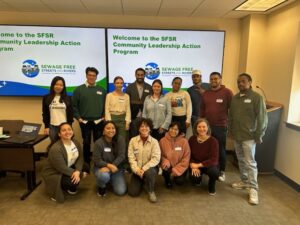
Over the summer, the Sewage-Free Streets and Rivers (SFSR) campaign graduated its fourth cohort of Community Leadership Action Program (CLAP) members. Held over five sessions from June to August, the participating individuals were community members from the combined sewer overflow (CSO) communities of Jersey City and North Bergen, who wanted to increase their understanding of the environmental impacts of CSOs, enhance their leadership and advocacy skills, and explore how the issue of CSOs can intersect with the work they do for their communities. 

Themes that Guided Our Conversations

The program explored several themes that helped participants understand the CSO issue, how it interconnects with other environmental justice issues, and reflect on their personal advocacy journey.

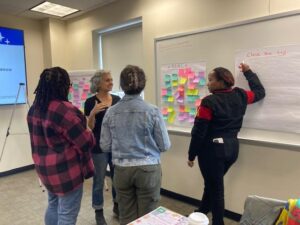
  1. Why is my city flooding? – Participants learn the basics of the CSO issue, including the historical context, environmental impacts, and progress made to addressing it so far.
  2. The Story of Self: Communicating your story effectively – Explores their core values, experiences, and motivations for getting involved in this type of work. It highlights the importance of community voice and the role it has on influencing CSO solutions.
  3. The Importance of Community Organizing – We cannot do this work alone. The focus for this session in on the importance of partnerships and cross-collaboration between local community groups and statewide collaboratives/organizations. 
  4. Understanding Water Policy – The basics of water policy and what it takes to effect change at different levels, from state to local, to national.
  5. Leadership in Action – Discussions on how participants can continue their personal advocacy in solving CSO solutions.

Key Takeaways from the Program

“I found this program expanded my knowledge about CSOs and also provided ‘story’ techniques for advocacy in this and other areas. I found the in-person sessions most effective, especially Session 5, in which there was great interaction between speakers and students.” – Maureen Crowley, Jersey City

“I’ve learned about CSOs and underground sewage issues. This program has opened my eyes to overlooked issues. I will continue to educate people on this matter, lead by example, and pass on this information to my camp children.” – Steven Felton, Jersey City

“I learned how to grasp an issue as complex and complicated as CSOs and make it understandable for others. I also learned how to build coalitions with others while competing with intersecting issues.” – Adrian Ghainda, Jersey City

“I learned how CSOs and sewer plants work. I also learned that there are so many people behind them. I also now understand the importance of the community outreach programs we promote at our school. I plan to continue spreading awareness on CSOs and the importance of access to clean waterways.” – Maki Vilomar, Jersey City

Guest Speaker Testimonials

“There is no power worth having that isn’t built at the granular level. Power building from the bottom is what creates real movements. Nothing is done without community power because everything is done for the community. It’s like building a house with no foundation. Knowledgeable and informed residents mean different perspectives looking at the same problem. When a wealth of community experiences comes together to problem solve, you begin to get solutions and outputs greater than anyone could think. Residents have the perspective to come up with their own solutions, and being informed makes those solutions possible.” – Anthony Diaz, Newark Water Coalition

“When communities understand their collective strength, they can begin to shape the systems and policies that most directly impact their lives. Granular power is where real change begins, from the ground up. It’s in the neighborhood meetings, the front stoop conversations, the community gardens, the local nonprofit groups. These spaces build power, deepen relationships, and create a sense of stewardship that leads to action and empowerment. When people are equipped with knowledge, they are powerful; and they become active participants in the shaping of their own futures. Informed communities are not only more resilient, but they are better positioned to demand and design solutions that are truly responsive and meaningful, solutions that reflect their lived realities, their cultural wisdom, and their hope for the future of their communities. Real transformation takes root slowly, intentionally, and collectively, one person at a time.” – Michele Langa, NY/NJ Baykeeper & Hackensack Riverkeeper, SFSR advisory board member

“In order to develop power at the granular level, you must first create informed residents on the ground so that they, along with others, can help achieve solutions that are more responsible to the community. But it’s more than just giving people information. At this time, all of us are inundated with information from myriad sources. Some of it might be correct, some of it might not. Some of it might be applicable, some of it might not. So rather than just possessing information, residents need to develop knowledge and the means to transmit that knowledge to others in their communities. That’s why a program like CLAP is so valuable: a forum to bring stakeholders together for face-to-face conversations and the transfer of knowledge. When environmental projects are being considered in a community, that knowledge allows community members to play a more meaningful role in the decision-making process by being able to bring attention to local conditions that those responsible for such projects might not otherwise be aware of. Similarly, knowledgeable local residents provide for more productive conversations surrounding various options for the implementation of such projects. Ultimately, this leads to better outcomes.” – Michael Witt, Passaic Valley Sewerage Commission

Lessons Learned Over The Four Cohorts
Four cohorts have been held since 2022.
First cohort: Statewide across 21 CSO communities, 2022
Second cohort: Jersey City, 2023
Third cohort: North Hudson Sewerage Authority service area, 2024
Fourth cohort: Passaic Valley Sewerage Commission, service area, 2025

With its first cohort taking place in 2022, the CLAP program aimed to build capacity within CSO towns by providing grassroots community members and leaders an opportunity to deepen their knowledge of local flooding and CSO issues, clarify solutions that would make a difference, and build a network of peers advocating for an equitable, sustainable, and climate-resilient future. The program has adapted over the course of four cohorts. Lessons learned include:

  • Flexibility in program curriculum. As the program progresses, it is important to tailor the curriculum in response to participants’ feedback. In some cases, we have updated the order of the lessons to suit their needs and invited specific individuals or groups, like the local water utility, to speak at sessions.
  • Be intentional with cohort focus areas. The first cohort took place virtually, which enabled the program to include participants from all across the 21 CSO communities in New Jersey. While a statewide approach allowed for a broader overview of the issue and fostered connections between different communities, the following cohorts took a more localized approach. The second cohort took place in one city and the following cohorts were focused within specific regional areas based on the wastewater treatment plant service area. Focusing on a specific region has allowed for increased ownership among community members and stronger trust to be built between participants. It has also enabled participants to develop solutions tailored to their community’s needs and personal advocacy work. 
  • Knowledge building by filling in gaps and making connections. CLAP participants enter the program with varying levels of understanding of flooding issues and CSOs. For some people, the first session is their introduction to CSOs. To make it worthwhile for the participants, it is essential to connect the issue of CSOs to the broader issue of water inequities and how it relates to other environmental justice issues that their communities face.

How We Move Forward

With some CSO communities already in the implementation phases of the five-year CSO permits, there are only 2.5 regional areas that need finalized permits. Ensuring the transparency of implementation schedules and projects, as well as accountability for permittees meeting their requirements, will take precedence for SFSR and its partners, including the CLAP alumni. Accountability around finalized permits will require monitoring by impacted community members and grassroots organizations. Even after permits are finalized, the anticipated change in administrations at the state level will require direct advocacy with municipalities. Partnerships with community organizations will be necessary to ensure the public is engaged and actively participating on the NJDEP-required CSO Supplemental Teams. 
SFSR Submitted Public Comments for the Passaic Valley Sewerage Commission’s Draft CSO Permits!

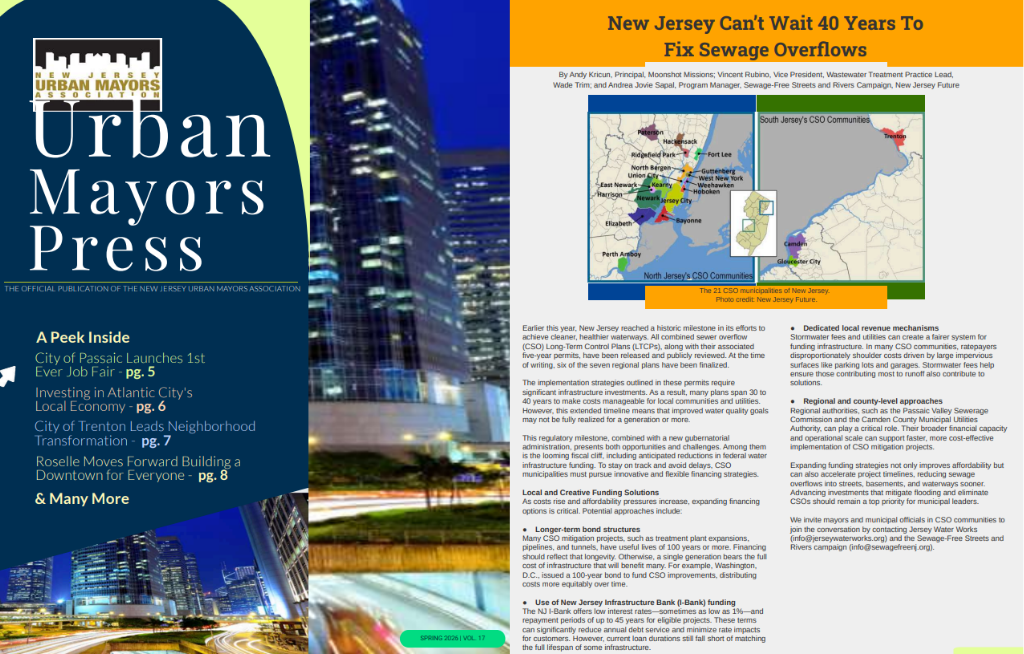
In March, NJDEP released the draft Combined Sewer Overflow permits for eight municipalities within the PVSC service region, including Bayonne, East Newark, Harrison, Jersey City, Kearny, Newark, North Bergen, and Paterson.

Notice of this draft permit action appeared on the Division of Water Quality’s website at www.nj.gov/dep/dwq, in The Herald News and Star Ledger, and in the March 19, 2025 DEP Bulletin. The DEP Bulletin is available on the internet at http://www.state.nj.us/dep/bulletin.

View the SFSR comments here.

View the recording of our April 8 workshop, where we highlighted key recommendations for the permit, the importance of public engagement, and best practices for advocating to NJDEP.

SFSR Community Leadership Action Program 2025

UPDATE: The final session of the 2025 Community Leadership Action Program took place in August! If you would like to be considered for our next cohort in 2026, email [email protected] with the subject line – CLAP 2026.

Join the Sewage-Free Streets and Rivers Campaign’s– 

Community Leadership Action Program

Are you concerned about increased flooding and polluted waterways in your community? Do you want to help your community solve these problems while enhancing your advocacy and leadership skills and building a network of peers who are making an impact?

Join a network of peers who want to be part of the solution and help lead efforts to solve this critical issue!

Community members from the following municipalities are invited to apply to this spring/summer program:

  • Bayonne
  • East Newark
  • Harrison
  • Jersey City
  • Kearny
  • Newark
  • North Bergen
  • Paterson

APPLY HERE


Sewage-Free Streets and Rivers (SFSR) Community Leadership Action Program is a five-session cohort-based program that provides grassroots community members and leaders residing in New Jersey’s Combined Sewer System communities with an opportunity to deepen their knowledge of local flooding and combined sewage overflow (CSO) issues, enhance their leadership and advocacy skills, and explore the best ways to take positive action for themselves and their community.


Program Participant Takeaways

  • Learn why their neighborhoods are flooding and raw sewage is discharging into waterways.
  • Clarify the solutions that will make a difference.
  • Discover new ways to advocate and influence decision-makers.
  • Build a network of peers advocating for an equitable, sustainable, climate-resilient future.

Planned Session Dates

  • Session 1: Saturday, June 28, 10am-1pm (in-person – location TBD)
  • Session 2: Thursday, July 17, 6-8pm (virtual)
  • Session 3: Thursday, July 31, 6-8pm (virtual)
  • Session 4: Thursday, August 7, 6-8pm (virtual)
  • Session 5: Saturday, August 16, 10am-1pm (in-person field trip)

Program Testimonials

“I greatly enjoyed the opportunities for networking, brainstorming, and hearing from experts. I think this served as a major education session for community leaders as well.”

 “Very engaging! Great speaker choices. Enjoyed the well-rounded topics and the detailed presentations, especially about successful community organizing and ways to participate in influencing the Jersey City council, and promote green infrastructure initiatives around JC.”

“This program allowed me to meet and network with local activists while gaining the knowledge needed to advocate for my neighbors.”

“I found the training super informative and loved all the guest speakers. The facilitator did a great job bringing the entire group together. I left all our meetings feeling empowered and inspired.”

“The program was very educational and well-organized. The cohort was collaborative, and each person brought their invaluable perspective.”

“Very well put together; great mix of people from different communities and clear problem and action plan on fighting it. Educational opportunity for all.”